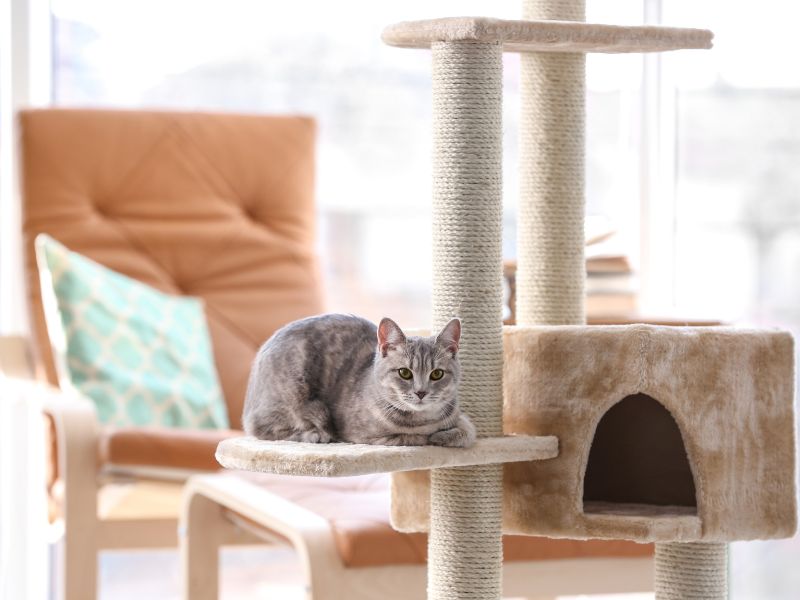
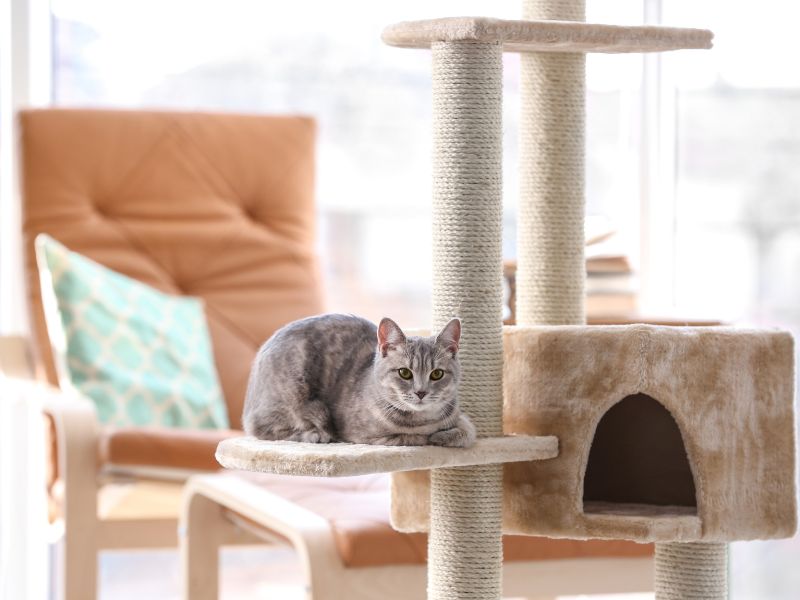
You cannot stop a cat scratching, and International Cat Care says you should not try: scratching is normal and necessary behaviour. What you can do is give your cat somewhere more attractive to scratch than your sofa. This guide sets out a six-step plan, starting with working out what your cat is actually looking for.
Why cats scratch
International Cat Care gives several reasons, and each one shapes what a good alternative looks like.
- Claw care. Dragging the claws downwards, known as stropping, loosens and removes the worn outer layer of each claw and exposes a sharp new surface underneath.
- Exercise. Scratching works the muscles of the front legs and spine.
- Marking. Glands between the paw pads leave scent as the claws scrape down a surface. The scratch marks, shed claw husks and smell together send a message to other cats.
- Security and confidence. Indoors, the scent left behind may help a cat feel safe. Cats also scratch vigorously in front of their owners or other cats as a sign of confidence, and some learn that scratching gets attention.
Kittens start scratching from around five weeks of age. Because the behaviour meets real needs, the goal is to redirect it, not to stop it.
Step 1: Work out where and how your cat scratches
Before you buy anything, spend a few days noting what your cat does. International Cat Care says each cat has its own preferences for surfaces and for scratching upright or flat, and that the alternative you offer should feel similar to the thing being damaged.
- Which surface? Fabric sofa arms, carpet, a stair, wallpaper, wood?
- Upright or flat? Does your cat stretch up a vertical surface, or lie down and pull at the carpet?
- How high? Note how far up the scratch marks reach.
- When? Cats Protection notes that cats often scratch and stretch when they wake up.
- One spot or many? If the scratching is spread around the home, especially near doorways and windows, International Cat Care says your cat is likely signalling a general sense of insecurity. Read Step 6 as well.
- How many cats share the home?
Step 2: Offer an alternative that feels the same
Use your notes to choose what to offer. The suggestions below are based on International Cat Care and Cats Protection guidance.
| What your cat damages | What to put right beside it |
|---|---|
| The side or arm of a sofa or chair | A tall, heavy, upright post your cat can scratch at full stretch |
| Carpet, often the bottom stair, scratched while lying down | A flat scratching mat, or sections of old or sample carpet placed near the stairs |
| Textured wallpaper at a certain height | An upright surface with a similar texture and ridges that reaches the same height |
| Wooden furniture, door frames or banisters | A post or panel made of wood, near the damaged area |
| Anything, if your cat is a kitten or elderly | Softer angled or flat cardboard scratchers, which some prefer because they give less resistance |
What makes a post worth using
- Height. International Cat Care says an upright post should be as tall as your cat standing on its hind legs at full stretch. If your adult cat still has the short post it had as a kitten, International Cat Care suggests upgrading to a taller one. In an online survey of more than 4,000 cat owners (Wilson and colleagues, 2016, summarised by Companion Animal Psychology), cats with posts over 3 ft (about 90 cm) tall were less likely to scratch in unwanted places.
- Stability. Lightweight posts that move during use do not give enough resistance, and International Cat Care says cats may not like them. Cats Protection recommends a heavy, stable base so the post does not wobble or topple.
- Surface. In the same survey, owners reported that their cats preferred rope (sisal) posts, while owners of cats aged 10 or over more often reported a preference for carpet. Cats Protection notes that a vertical weave helps a cat run its claws downwards. If your cat already uses a carpet-covered post, there is no need to swap it: International Cat Care says there is no evidence that scratching moves onto other carpeted areas once a carpet post is used regularly.
- Wall-mounted panels. International Cat Care suggests fixed panels when space is short. The owner survey found that posts hung on or fixed to a wall were linked with more unwanted scratching, so if you use a panel, fix it firmly and offer a freestanding post as well if you can.
Step 3: Put the post where your cat wants to scratch
Location matters as much as the post.
- Right beside the damaged spot. Cats Protection suggests placing a post next to the area your cat has been scratching. Once your cat uses it, you can move it gradually to a more convenient place.
- Near your cat’s favourite bed, because cats often scratch after sleeping (International Cat Care).
- In an area where your cat spends a lot of time (International Cat Care).
- One per cat, plus one. For multi-cat homes, International Cat Care recommends one post per cat plus an extra one, in different locations. Cats Protection adds that separate locations help avoid conflict.
Step 4: Make the post rewarding
International Cat Care and Cats Protection suggest several ways to draw your cat to a new post:
- Catnip. Rub catnip on the post, or choose one infused with it. This draws the attention of cats that respond to catnip, though not all cats do.
- Play. Drag a wand toy around the base of the post. Once your cat’s claws touch the surface, this is often enough to start the habit.
- Food. Put a few treats or pieces of your cat’s food around the base or on the post.
- Praise and treats when it is used. In the owner survey, owners who rewarded their cats with food, petting or praise for using the post were significantly less likely to report a scratching problem. Telling the cat off, removing it or redirecting it when caught scratching had no effect on scratching behaviour.
- A visual cue. International Cat Care suggests pre-scratching the post lightly with the tip of a screw.
Never pick your cat up and press its paws onto the post. International Cat Care warns that this can frighten your cat, put you at risk of injury and damage your bond.
Step 5: Protect the furniture for now
While the new habit forms:
- Cover the target area with a thick, heavy blanket or one-sided sticky plastic film (International Cat Care), or thick, shiny plastic sheeting (Cats Protection). These protect the surface and make it less attractive to scratch.
- Clean wooden surfaces that have been scratched with unscented soapy water (International Cat Care).
- Consider a synthetic feline pheromone spray on previously scratched areas. International Cat Care says these products can help a cat feel more secure and make scratching for territorial reasons less likely. Ask your vet whether one suits your cat.
- Remove the covers once your cat is using the post, as Cats Protection suggests.
Step 6: Check whether stress is behind it
International Cat Care says scratching may be anxiety-related if it is widespread around the home, if you have several cats, or if many cats live nearby. Major building work in the home can also set off intense scratching while a cat adjusts. Tension between cats is often hard for owners to see.
- Add resources. International Cat Care suggests extra bowls, litter trays, scratching posts and beds around the home so cats do not have to compete.
- Ask for help. If you suspect anxiety, contact your vet for advice or ask for a referral to a feline behaviour specialist. Cats Protection also recommends a qualified behaviourist to uncover the cause.
What not to do
- Do not punish. International Cat Care says your cat should never be punished. Punishing a natural behaviour confuses a cat, and if the scratching comes from anxiety, punishment adds to the distress and is likely to make things worse.
- Do not rely on claw trimming. International Cat Care says trimming may prevent immediate damage but does not meet your cat’s need to scratch. Older cats may need regular trims because they cannot scratch as easily, and very overgrown or thickened claws can be a sign of illness, so ask your vet if you see them.
- Do not declaw. Declawing is the amputation of the last bone of the toe, known as the third phalanx. The American Association of Feline Practitioners strongly opposes it as an elective procedure and lists chronic nerve pain and behaviour problems among its long-term complications. A study of 274 cats, half of them declawed, found declawed cats had higher odds of back pain and of unwanted behaviours including biting, aggression and toileting outside the litter tray. Declawing is illegal in the UK, and the RSPCA notes that it remains legal in other parts of the world.
- Do not judge a post by how it looks. International Cat Care explains that the visible marks, shed claw husks and scent left by scratching are all part of the message a cat leaves. A shredded post is one your cat is using, so there is no need to replace it for looks alone. Replace it when it becomes unstable or too short for a full stretch.
When to talk to your vet
- Scratching is widespread, sudden or intense, or you think stress is involved.
- Your cat’s claws look overgrown or thickened, or catch on soft furnishings.
- An older cat stops using its post or seems stiff when stretching.
Quick checklist
- I know which surface my cat targets, whether it scratches upright or flat, and how high it reaches.
- The new post matches that surface and direction.
- It is at least as tall as my cat at full stretch and does not wobble.
- It sits right beside the damaged spot or near my cat’s bed.
- There is one post per cat plus one, in different places.
- I reward every use with a treat, play or praise.
- The furniture is covered for now, and I will remove the covers once the post is in use.
- If scratching is widespread or sudden, I will talk to my vet.
Sources
- Scratching on furniture and carpets, International Cat Care (accessed 5 October 2026)
- Cats and scratching, Cats Protection (accessed 5 October 2026)
- What kind of scratching post do cats prefer? (summary of Wilson et al. 2016, Journal of Feline Medicine and Surgery), Companion Animal Psychology (accessed 5 October 2026)
- AAFP Position Statement: Declawing (Journal of Feline Medicine and Surgery, 2017), American Association of Feline Practitioners, via PubMed Central (accessed 5 October 2026)
- Pain and adverse behavior in declawed cats (Martell-Moran, Solano and Townsend, Journal of Feline Medicine and Surgery, 2018), Journal of Feline Medicine and Surgery, via PubMed Central (accessed 5 October 2026)
- Tough new law will help see the end of cruel dog ear cropping and cat declawing, RSPCA (accessed 5 October 2026)
This article is general information, not a substitute for advice from your own veterinarian. If you are worried about your pet, please contact your vet.
🐾 The Meow Howl newsletter
New pet care guides, in your inbox
Join fellow dog & cat parents. We'll let you know when we publish new guides and tools. No spam.