No breed can promise that a dog will be safe or easy with children. Every dog is an individual, and how it is bred, raised, trained and supervised matters, not just its breed. This guide helps you narrow the choice in three steps: a checklist for the whole family, the practical trade-offs of breeds often suggested for family homes, and the safety rules that apply to every dog.
Keep one point in mind throughout. The RSPCA notes that people are far more likely to be bitten by a dog owned by their own family than by an unfamiliar dog. One of its key rules is to never leave a child alone in the same room as a dog, even your own.
(First dog in the family? Our guide to choosing your first dog covers the time, training, grooming and running costs to plan for.)
Start with your family, not the breed
Answer these questions together before you look at breeds.
- How old are your children? A large, bouncy young dog can easily knock over a toddler. A very small dog can be hurt if it is dropped, squeezed or stepped on. Babies and toddlers mean constant supervision, so choose a dog that fits around that.
- Which adult is responsible? Children can help, but an adult needs to own the feeding, walks, training, vet visits and supervision every day for the whole of the dog’s life.
- How much time do you have on a normal school day? The Royal Kennel Club’s breed guides range from up to 30 minutes of exercise a day for some small companion breeds to more than two hours for many gundogs.
- How much grooming can you keep up? Some coats need a brush once a week. Others need daily care.
- Does anyone have a dog allergy? No breed is proven to be allergy-free (see below), so settle this before you fall for a particular dog.
- Where do you live? Some breeds are restricted or prohibited in some countries, including the UAE (see below).
Breeds often suggested for families: how they compare
The breeds below are often described as good family dogs. The figures are the Royal Kennel Club’s general guide for each breed. Individual dogs vary, so treat them as a starting point rather than a promise.
| Breed | Size | Exercise a day | Grooming | Lifespan |
|---|---|---|---|---|
| Labrador Retriever | Large | More than 2 hours | Once a week | Over 10 years |
| Golden Retriever | Large | More than 2 hours | More than once a week | Over 10 years |
| Hungarian Vizsla | Large | More than 2 hours | Once a week | Over 12 years |
| Boxer | Large | More than 2 hours | Once a week | Over 10 years |
| Bernese Mountain Dog | Large | Up to 1 hour | More than once a week | Under 10 years |
| Newfoundland | Large | Up to 1 hour | Every day | Under 10 years |
| Rough Collie | Large | Up to 1 hour | Every day | Over 12 years |
| Standard Poodle | Medium | Up to 1 hour | Every day | Over 12 years |
| Beagle | Small | Up to 1 hour | Once a week | Over 12 years |
| Cavalier King Charles Spaniel | Small | Up to 1 hour | More than once a week | Over 12 years |
| Bichon Frise | Small | Up to 30 minutes | Every day | Over 12 years |
| Havanese | Small | Up to 30 minutes | Every day | Over 12 years |
What to weigh up with each breed
- Labrador and Golden Retrievers. The Royal Kennel Club puts the Labrador’s popularity partly down to its versatility as a family companion, and it describes gundogs, the group both retrievers belong to, as good companions for families. Both retrievers are large and strong with high exercise needs, so start training early and supervise play with small children. The Royal Kennel Club lists hip, elbow and eye screening for both breeds: ask the breeder for the parents’ results. If you live somewhere hot, note that Golden Retrievers had 2.65 times the odds of heat-related illness compared with Labradors in UK veterinary records.
- Hungarian Vizsla. This breed suits a family that already spends a lot of time outdoors, because the Royal Kennel Club’s guide is more than two hours of exercise a day.
- Boxer. The Royal Kennel Club calls the breed “lively, strong and family-orientated”. That strength and energy mean play with young children needs close supervision, as it does with any dog. The UK study of veterinary records quoted above for the Golden Retriever describes the Boxer as a flat-faced (brachycephalic) breed. Boxers in that study showed a trend towards higher odds of heat-related illness than Labradors, although the result was not statistically significant. The Boxer is on the dangerous-dog list in the original text of the UAE’s 2016 law, so if you live in the UAE, check the current list (see below).
- Bernese Mountain Dog and Newfoundland. Both are large dogs with an exercise guide of up to an hour a day, but their coats need regular care: more than once a week for the Bernese and every day for the Newfoundland. The Royal Kennel Club gives both a lifespan of under 10 years, so a family is likely to have fewer years with one than with many smaller breeds.
- Rough Collie. Its coat needs grooming every day. The Royal Kennel Club lists eye and hip screening and several DNA tests for the breed, so ask the breeder which ones the parents have had.
- Standard Poodle. The Royal Kennel Club lists the breed as non-shedding, but its coat needs daily care. Low shedding does not make a dog safe for someone with a dog allergy (see below).
- Beagle. The Royal Kennel Club describes the Beagle as the smallest of the British pack hounds, bred to hunt small game, with a “friendly, affectionate nature”. Expect a dog that likes to follow its nose.
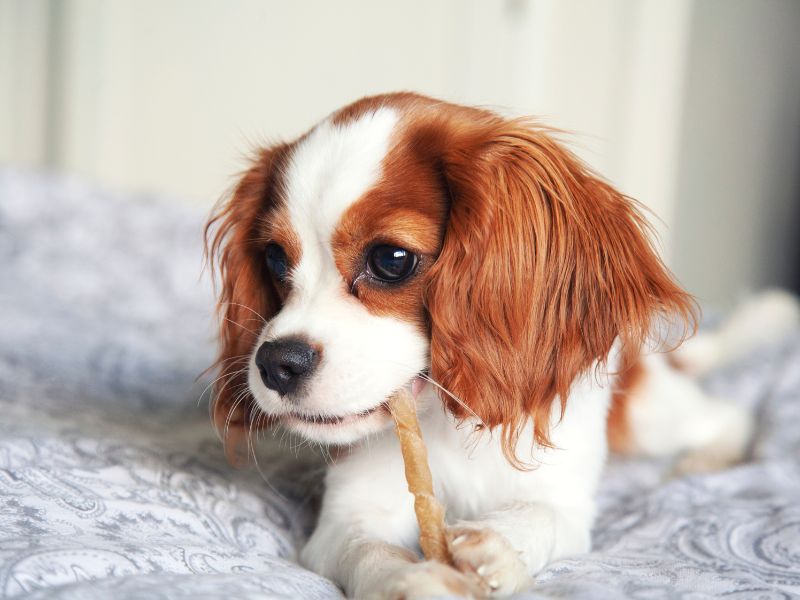
- Cavalier King Charles Spaniel. A small dog with moderate exercise needs, but a breed with known inherited health problems. The Royal Kennel Club says mitral valve disease, a heart condition common in older dogs of all breeds, has been found to start earlier in the Cavalier. It also describes syringomyelia, where fluid-filled cavities develop in the spinal cord and can cause pain and neurological problems in some dogs. Ask whether the parents were graded under the Royal Kennel Club heart scheme, and talk to your vet about the breed before you commit. Cavaliers also had 3.45 times the odds of heat-related illness compared with Labradors in UK veterinary records.
- Bichon Frise and Havanese. Small companion dogs with the lowest exercise guide on this list, but both need coat care every day. A small dog can be hurt by rough handling, so teach children to stroke it gently while sitting down rather than picking it up.
Why the Bulldog and the Pug are no longer on this list
This page no longer recommends the Bulldog or the Pug. Both are flat-faced (brachycephalic) breeds with well-documented health problems.
- In a UK study of 604 Pugs, French Bulldogs and Bulldogs, 51.2% of the Bulldogs and 64.6% of the Pugs assessed were classed as affected by brachycephalic obstructive airway syndrome (BOAS), a breathing disorder (Liu and colleagues, 2017). The dogs studied included pet dogs, show dogs and some dogs referred to a university veterinary hospital for breathing problems, so these figures are not an exact rate for every dog of these breeds.
- In UK veterinary records from 2016, Bulldogs had 13.95 times the odds of heat-related illness compared with Labradors (Hall, Carter and O’Neill, 2020).
- The RSPCA lists breathing, skin, eye and joint problems in flat-faced breeds and says the costs of owning one are “far higher and frequent than with other breeds”. It encourages people to consider healthier breeds or adoption.
The RSPCA also advises watching out for parents with exaggerated features, such as “a very short flat face or very wrinkled skin”, whatever the breed. If your family has its heart set on a flat-faced dog, talk to your vet first.
Dog allergies: what “low-shedding” does and does not mean
Poodles, Bichons and similar breeds are often promoted as “hypoallergenic” because they shed less. The American Academy of Allergy, Asthma and Immunology says no dog is truly allergen-free and that there is no consistent evidence these breeds produce fewer allergens. If someone in your family has a dog allergy, speak to an allergist before you choose, and spend time with the specific dog before you commit. Our vet-written guide to hypoallergenic dog breeds explains more.
Rescue dogs and mixed breeds
A rescue dog can be a good choice for a family. RSPCA rehoming teams assess the individual animal alongside your lifestyle, home and experience before they suggest a match. Tell the rescue the ages of your children and how busy your home is. Ask how the dog has behaved around children and visitors while in their care. With an adult dog, its size, coat and energy level are already known, which removes some of the guesswork of a puppy.
Meeting a dog with your children
- Go without the children first if you can, so you can watch the dog calmly and ask questions.
- See a puppy with its mother. The RSPCA advises meeting puppies with their mum and littermates in the place where they were born and raised. It warns that if the mother is not there, the puppy was not bred there. Ask whether the parents were screened for inherited diseases known to affect the breed.
- Let the dog come to the children, not the other way round, and keep the first meeting short and calm.
- Watch the dog’s body language. The RSPCA describes a worried dog as one that tucks its tail, puts its ears back, yawns, licks its lips, lowers its head, avoids eye contact or turns its head away. If you see these signs, give the dog space and end the meeting.
- Meet more than once before you decide.
House rules for children and dogs
These rules follow RSPCA advice and apply to every dog, however gentle.
- Never leave a child alone in the same room as a dog, even your own and however much you trust it.
- Teach children not to approach a dog that is eating or has a treat, is playing with a toy it really likes, is sleeping, unwell, injured or tired, or is blind or deaf.
- Teach children to be gentle. Don’t let them climb on the dog or pull its ears, or do anything to it you would not let them do to another child.
- Give the dog a quiet place of its own, such as a cosy spot in a quiet room, and teach children to leave the dog alone when it is there.
- If the dog looks unhappy, let it move away to somewhere it feels safe.
- Show children how to play nicely. With an adult watching, a child can teach the dog simple tricks such as giving a paw.
- Don’t let children approach dogs they don’t know, such as dogs they meet in the park.
Any dog can bite, whatever its breed or size. Our guide to why dogs bite and how to stop it, written by a vet, explains the warning signs in more detail.
Living in the UAE
Federal Law No. 22 of 2016, published on the UAE government portal, lets the ministry keep a list of dog breeds that people are prohibited from keeping, trading or breeding, and the list has been amended since the law was published. The law’s original text and a 2021 Gulf News report on an update name different breeds, so we do not reproduce either list here. The same law requires a licence to keep any dog and requires dogs to be on a lead outside their home. Check the current list with the Ministry of Climate Change and Environment and your local authority before you choose a breed.
The bottom line
Choose the individual dog, not the label. Match its size, exercise and grooming needs to your family’s real routine, check health tests and local rules, and agree the house rules before the dog comes home. Whatever the breed, never leave children and a dog alone together.
Sources
- Dogs and children, RSPCA (accessed 5 October 2026)
- Understanding your dog's body language, RSPCA (accessed 5 October 2026)
- Should I get a pet?, RSPCA (accessed 5 October 2026)
- Finding a good puppy breeder, RSPCA (accessed 5 October 2026)
- Healthier breeds, happier dogs, RSPCA (accessed 5 October 2026)
- Conformational risk factors of brachycephalic obstructive airway syndrome (BOAS) in pugs, French bulldogs, and bulldogs, PLOS ONE (Liu et al., 2017) (accessed 5 October 2026)
- Incidence and risk factors for heat-related illness (heatstroke) in UK dogs under primary veterinary care in 2016, Scientific Reports (Hall, Carter and O'Neill, 2020), via PubMed Central (accessed 5 October 2026)
- Hypoallergenic Dogs and Dog Allergies: Myths, Facts and What You Should Know, American Academy of Allergy, Asthma and Immunology (accessed 5 October 2026)
- Retriever (Labrador) breed profile, The Royal Kennel Club (accessed 5 October 2026)
- Retriever (Golden) breed profile, The Royal Kennel Club (accessed 5 October 2026)
- Hungarian Vizsla breed profile, The Royal Kennel Club (accessed 5 October 2026)
- Boxer breed profile, The Royal Kennel Club (accessed 5 October 2026)
- Bernese Mountain Dog breed profile, The Royal Kennel Club (accessed 5 October 2026)
- Newfoundland breed profile, The Royal Kennel Club (accessed 5 October 2026)
- Collie (Rough) breed profile, The Royal Kennel Club (accessed 5 October 2026)
- Poodle (Standard) breed profile, The Royal Kennel Club (accessed 5 October 2026)
- Beagle breed profile, The Royal Kennel Club (accessed 5 October 2026)
- Cavalier King Charles Spaniel breed profile, The Royal Kennel Club (accessed 5 October 2026)
- Bichon Frise breed profile, The Royal Kennel Club (accessed 5 October 2026)
- Havanese breed profile, The Royal Kennel Club (accessed 5 October 2026)
- Federal Law No. (22) of 2016 Regulating the Possession of Dangerous Animals (English text), UAE Government portal (u.ae) (accessed 5 October 2026)
- UAE updates list of dog breeds banned in the country, Gulf News (accessed 5 October 2026)
This article is general information, not a substitute for advice from your own veterinarian. If you are worried about your pet, please contact your vet.
🐾 The Meow Howl newsletter
New pet care guides, in your inbox
Join fellow dog & cat parents. We'll let you know when we publish new guides and tools. No spam.