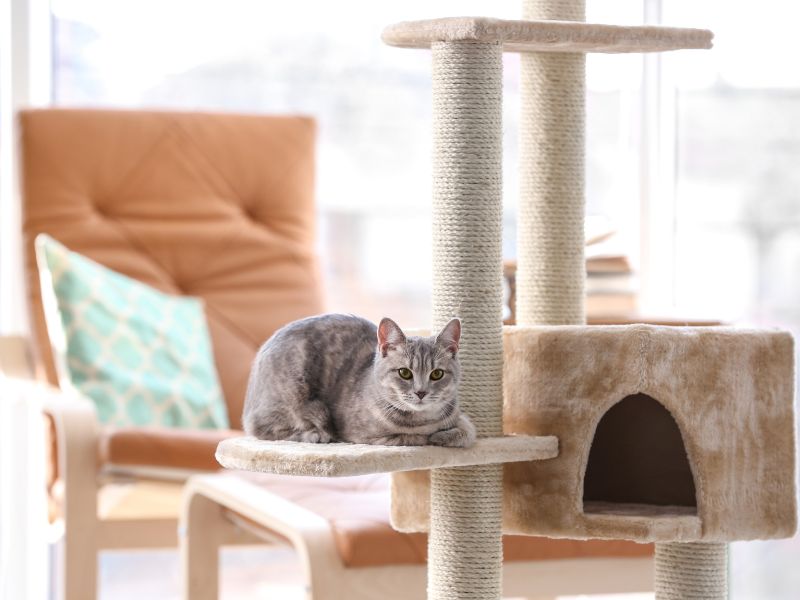
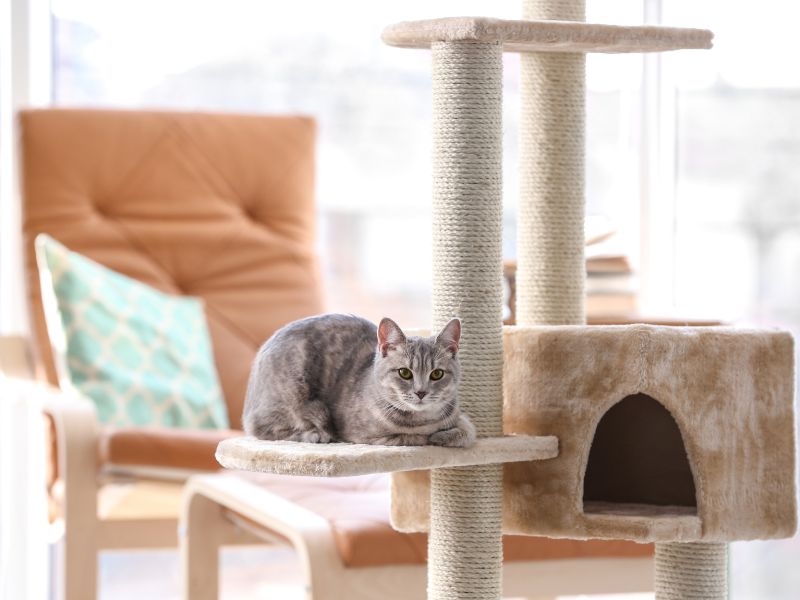
You want to give your cat somewhere to climb, perch and scratch, but a small flat has little floor to spare. This is a selection guide. It compares the main types of cat tree and climbing space, explains what to check and why, and says who each option suits. It is not a product test or review: Meow Howl has not tested any cat tree, and this guide does not name brands or models.
Why cats need height and somewhere to scratch
International Cat Care describes cats as natural climbers that rest and watch their surroundings from high places, because that is where they feel safe. The AAFP and ISFM Feline Environmental Needs Guidelines, written for vets, say that access to an elevated area increases a cat’s vertical space and lets it monitor its environment. They describe a cat’s safe place as private and secure, often in a raised location.
Scratching is normal behaviour, not a fault to train out. International Cat Care explains that it keeps claws healthy, exercises the muscles of the front legs and spine, and leaves scent that marks territory. The RSPCA says a scratching post needs to be tall and sturdy enough not to tip over when your cat stretches up fully.
In a small home, a cat tree or a wall route can provide both: height without using much floor, and a scratching surface that is not your sofa. Existing furniture counts too. International Cat Care lists shelves and freestanding cupboards and wardrobes as suitable high resting places, and notes that a bookshelf can work if a small area is cleared for your cat.
The main types compared
| Type | How it works | Suits | Watch out for |
|---|---|---|---|
| Tall, narrow cat tree | Posts and platforms stacked on a small base | One agile cat, a corner with little floor | A tall tree on a small base is more likely to rock or tip. Check whether it can be strapped to a wall. |
| Wide-base, multi-level tree | Several platforms, often with a bed or hideaway, on a larger base | Several cats, large or heavy cats, homes where you cannot drill | Uses more floor. Beds and platforms may still be too small for a large cat. |
| Floor-to-ceiling pole | A pole held by pressure between floor and ceiling, with platforms attached | Studios and narrow spaces where you want height on a very small footprint | Needs a ceiling that suits the fitting and a height inside the stated range. The fit needs checking regularly. Few platforms means little room to share. |
| Wall-mounted shelves, steps and beds | Units fixed to the wall to make a climbing route | Confident climbers in homes with no spare floor | Needs secure fixings into a suitable wall and, in a rented home, permission to drill. Smooth shelves can be slippery. A single route can be blocked by another cat. |
| Standalone scratching post or scratcher | An upright post, or a flat or angled pad, with no climbing levels | Every home as an extra scratching spot, including kittens and older cats | Adds no height. A post must be tall and heavy enough for a full stretch. |
Features that matter and why
Platform and bed size. The AAFP and ISFM guidelines say perches should be wide and long enough for the cat to stretch out fully, and that a hammock-style dip in a perch helps a cat feel hidden. International Cat Care adds that cats are less likely to use beds on cat trees that are too small to rest in comfortably. Small platforms and cubbies save space but may only suit small cats.
Non-slip surfaces. International Cat Care warns that many wooden shelves are extremely slippery and recommends a non-slip surface. This matters most on wall shelves, where a cat lands on a narrow step.
Somewhere to hide. A covered bed or box on a tree can act as a safe place. In a home with more than one cat, the AAFP and ISFM guidelines say a safe place should have more than one way in, so another cat cannot easily block it.
Replaceable posts and washable covers. Scratching wears posts down. Posts or covers that unscrew and can be replaced keep a tree usable for longer, and washable bed covers are easier to keep clean. The AAFP and ISFM guidelines suggest washing bedding in rotation, so some items keep your cat’s familiar scent.
Stated weight limits. If your cat is large or heavy, check the maximum load the maker gives for each platform and for the whole unit, particularly for anything fixed to a wall.
Checks for a small home
Stability and anchoring
A unit that tips can injure your cat or a person nearby. Stability also affects whether your cat uses it: International Cat Care notes that some scratching products are too lightweight to support scratching or cannot be fixed to a rigid surface, and that cats may not like these because they do not give enough resistance.
- Freestanding trees. The taller the tree and the smaller its base, the more it matters to secure it. Use a wall strap or anti-tip fixing if one is supplied or can be fitted.
- Floor-to-ceiling poles. These rely on pressure against the ceiling. Follow the fitting instructions, stay within the stated ceiling height range, and check the fit regularly, because it can loosen.
- Wall shelves. Fix them into a wall that can take the load, using fixings suited to the wall type. If you are unsure what your wall is made of, ask a handyperson.
- After assembly. Push the top firmly from several directions. If it rocks, tighten the fittings or secure it before your cat uses it, and retighten bolts from time to time.
Height
More height gives more vertical territory, but it is a trade-off. International Cat Care advises making sure your cat can get down easily, especially older cats with limited mobility. The AAFP and ISFM guidelines suggest placing perches for kittens and less mobile cats at a lower height, or making them reachable by ramps. A tall tree or pole suits a young, agile cat. For an older cat, closely spaced levels and an easy way down matter more than total height.
For the scratching part of a tree, International Cat Care says the post should be as tall as your cat standing on its hind legs at full stretch. Measure your cat stretched up, then compare that with the length of unbroken scratching surface, not the total height of the tree.
Scratching surfaces
Cats differ. International Cat Care notes that each cat has its own preferences, including whether it likes to scratch a vertical or a horizontal surface, and that kittens and older cats may prefer softer horizontal or angled cardboard scratchers.
An online survey of more than 4,000 cat owners (Wilson and colleagues, 2016, summarised by Companion Animal Psychology) found that owners reported their cats preferred rope-covered posts. The authors suggested a post that is upright, at least 3 ft (about 90 cm) tall, has two or more levels and has a base 1 to 3 ft (about 30 to 90 cm) wide. Owners of cats aged 10 or over reported a preference for carpet and for simple vertical posts. Posts that hang from or are fixed to a wall were associated with more scratching in unwanted places, so if you choose wall shelves for climbing, give your cat a freestanding post as well. These are owner reports: they show associations, not proof that a particular post prevents unwanted scratching.
For redirecting scratching away from furniture, see How to Stop Your Cat Scratching the Furniture.
More than one cat
One large tree is one location. International Cat Care’s advice for multi-cat homes is one of each resource per cat plus one extra, in different locations, including resting places and scratching posts. It also suggests two access points to each perch where possible, so a cat cannot be trapped by another, and notes that cats may block or defend beds. The AAFP and ISFM guidelines call for at least as many safe places as there are cats.
In a small flat, that often means two smaller climbing spots in different rooms or corners rather than one big tree, plus a scratching post for each cat and one extra. On a single tree, look for platforms that can be reached by more than one route, and avoid designs where the only way up or down passes through one bed.
Footprint in a small space
- Least floor. Floor-to-ceiling poles and wall shelves use the least floor. A wide-base tree uses the most but is easier to keep steady without fixings.
- Use what you have. A cleared area of a bookshelf, or the top of a sturdy freestanding cupboard or wardrobe with a step to reach it, can add height without new furniture.
- Placement. International Cat Care suggests putting scratching posts where your cat spends a lot of time, such as near its favourite bed, because cats often scratch after sleeping. The AAFP and ISFM guidelines recommend that at least one indoor resting place gives a view of the outdoors.
Safety and limitations
- Windows and balconies. International Cat Care’s advice on high-rise cats is to move furniture that lets a cat reach higher-level open windows, and to use window restrictors, mesh or balcony nets. It notes that most cats injured in falls are young, many under a year old. If you put a tree by a window for the view, keep that window closed or fitted with a restrictor or mesh.
- Kittens and older cats. Keep levels low, or add ramps and intermediate steps, as described above.
- Rented homes. Wall fixings and tension poles may not be allowed, or may mark walls and ceilings. Check your tenancy agreement or ask your landlord first.
- What this guide cannot tell you. Meow Howl has not tested any product, so it cannot say how stable a particular model is, how it wears over time or whether its stated weight limits are accurate. Read the maker’s instructions and limits, and look for buyer reports that describe stability with cats of a similar size to yours.
- Strength of the evidence. The scratching findings above come from an owner survey and expert welfare guidance, not from controlled trials of cat trees.
When to talk to a vet or other professional
- Your vet. International Cat Care lists reluctance, hesitance or refusal to jump up or down, and jumping up or down less often, among the signs of arthritis in cats, and advises contacting your vet if you see them. If your cat stops using high places it used to reach easily, or struggles to get down, mention it to your vet. If your cat falls from a window or balcony, contact your vet even if it seems unhurt.
- Your vet, then a qualified behaviourist. International Cat Care lists hissing, chasing, swiping, fighting and blocking access to food or litter trays as signs of tension between cats. If you see these, or unwanted scratching continues despite suitable posts, speak to your vet, who can advise and, if needed, refer you to a veterinary or clinical animal behaviourist.
- A handyperson or your landlord. Ask before fixing shelves or a pole if you are unsure about the wall, the ceiling or your tenancy terms.
Before you buy
- Measure the floor space and, for a floor-to-ceiling pole, the ceiling height against the stated range.
- Measure your cat at full stretch. The scratching surface should be at least that tall.
- Check that platforms and beds are big enough for your cat to lie stretched out.
- Check the stated weight limits against your cat’s weight.
- Decide how it will stay put: a wide base, a wall strap, a tension fit or wall fixings, and whether your tenancy allows it.
- Choose a surface your cat already likes to scratch, with posts or covers you can replace.
- Count your cats: one resting place and one scratching post per cat plus one, in different spots, with more than one way on and off.
- For a kitten or an older cat, look for a low first step and an easy way down.
- Plan the position: somewhere your cat already spends time, and not one that gives access to an open window or balcony.
Sources
- Making your home cat friendly, International Cat Care (accessed 5 October 2026)
- AAFP and ISFM Feline Environmental Needs Guidelines (Journal of Feline Medicine and Surgery, 2013), American Association of Feline Practitioners and International Society of Feline Medicine (accessed 5 October 2026)
- Scratching on furniture and carpets, International Cat Care (accessed 5 October 2026)
- Looking after indoor and house cats, RSPCA (accessed 5 October 2026)
- What kind of scratching post do cats prefer? (summary of Wilson et al. 2016, Journal of Feline Medicine and Surgery), Companion Animal Psychology (accessed 5 October 2026)
- Multi-cat households, International Cat Care (accessed 5 October 2026)
- High-rise cats, International Cat Care (accessed 5 October 2026)
- Arthritis in cats, International Cat Care (accessed 5 October 2026)
This article is general information, not a substitute for advice from your own veterinarian. If you are worried about your pet, please contact your vet.
🐾 The Meow Howl newsletter
New pet care guides, in your inbox
Join fellow dog & cat parents. We'll let you know when we publish new guides and tools. No spam.