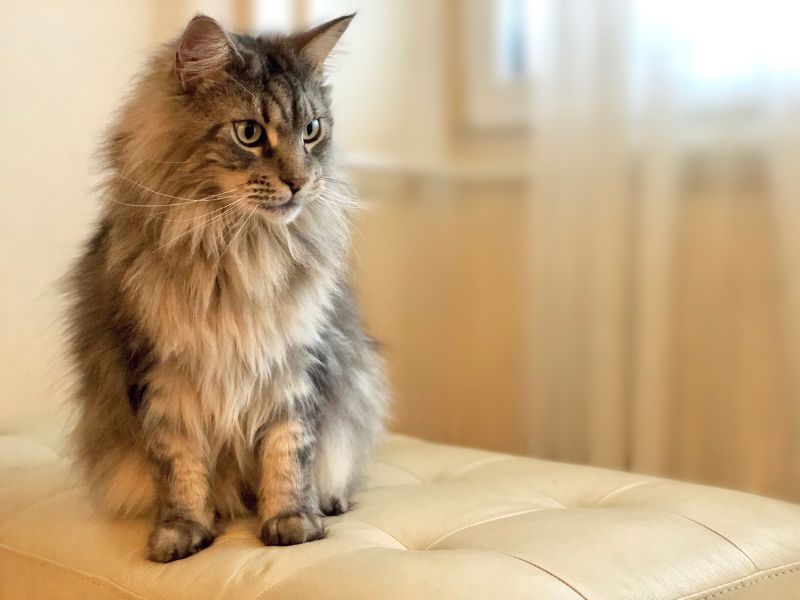
How do you choose a grooming tool that suits your pet’s coat, and use it without hurting the skin? This is a selection guide, not a product test or review. Meow Howl has not used or tested any of the tools described here. The guide compares the main tool types, the coats each one suits and the limits of grooming at home, based on published advice from animal welfare charities and veterinary sources.
Shedding itself is normal: old hair falls out as new hair grows. No brush stops it. Regular grooming removes loose hair, helps prevent tangles and mats, and gives you a regular look at your pet’s skin.
Tool types compared
| Type | How it works | Suits | Watch out for |
|---|---|---|---|
| Bladed deshedding tool | A fine-toothed metal edge on a handle reaches under the topcoat to catch loose undercoat. | Dogs with thick double coats, such as Huskies and Samoyeds, especially during a heavy shed. | Short, gentle strokes only. Never press hard or scrape the skin. Not the tool for tangles or mats (see Safe use below). Not suggested for curly or continuously growing coats, which VCA Animal Hospitals describes as non-shedding. |
| Undercoat rake | Long, widely spaced metal teeth reach down through a dense coat to lift out loose undercoat. | Thick double coats. The Royal Kennel Club also suggests a shedding rake for short-coated heavy shedders such as Labradors. | The same rules as a deshedder: short, gentle strokes, no hard pulling on the coat and no scraping the skin. |
| Slicker brush | Many fine, bent wire pins on a flat or curved head pull out loose hair and help remove knots. | Curly coats such as Poodles, medium and long coats, double coats alongside a rake, and long-haired cats. | Use short, gentle strokes and keep the wire pins from scraping the skin. |
| Metal comb | Teeth run through the coat down to the skin, finding knots and lifting loose hair. Wide-toothed, fine-toothed and dematting versions exist. | Most coat types. Wide or long teeth for long coats and long-haired cats, fine teeth for short coats and short-haired cats. | A comb that catches near the skin has found a knot. Tease the knot apart gently rather than dragging the comb through it. |
| Rubber brush or grooming glove | Rubber nubs grip and lift loose hair from the surface of the coat as you stroke. | Smooth-coated dogs such as Boxers and pointers, short-haired cats, and alongside a comb for long-haired cats. | Like other soft massage brushes, often not enough on its own to remove knots, mats and loose hair. |
| Bristle or pin brush | Bristles or pins smooth the coat and help spread its natural oils. | Short or soft bristles for short-coated dogs and short-haired cats. The RSPCA also lists soft bristle and pin brushes for cats. | Often not enough on its own to remove knots or mats. |
| Stripping knife | Used with the thumb to pull out the long guard hairs while leaving the softer undercoat in place. | Wire-coated breeds such as Border Terriers and Schnauzers. | A technique to learn from a groomer before trying it at home. |
Match the tool to the coat
Every source used for this guide organises its advice by coat type, so start there. The guidance below draws on the RSPCA, PDSA, International Cat Care, the Royal Kennel Club and VCA Animal Hospitals. Where those sources differ on how often to groom, both figures are given.
Short, smooth coats
Dogs such as Labradors, Staffordshire Bull Terriers and Boxers. The tools these sources suggest are a rubber brush or grooming glove, a short or soft bristle brush and a fine-toothed comb. Heavy shedders such as Labradors may also need going over with a shedding rake to remove dead undercoat. PDSA says short-haired breeds such as Staffies and Labradors may only need brushing once a week. The Royal Kennel Club suggests light grooming two or three times a week.
Double coats
Dogs such as Siberian Huskies, Samoyeds, Australian Shepherds, German Shepherds and many retrievers have an outer coat of guard hairs over a fine, soft undercoat. VCA Animal Hospitals notes that these dogs shed heavily twice a year. This is where an undercoat rake, a slicker brush, a wide-toothed comb and a deshedding tool all have a place.
RSPCA Australia advises grooming double coats normally every day, to stop dead hair that has not shed from building up and forming mats. PDSA suggests brushing a few times a week for medium coats such as German Shepherds. Either way, expect to do more during a heavy shed.
Clipping a coat short carries risks of its own. VCA Animal Hospitals advises leaving at least 2.5 cm (1 inch) of coat whenever a dog’s hair is cut, to avoid sunburn or sun damage to the skin. It also describes a rare complication called post-clipping alopecia, especially in plush-coated breeds such as Huskies and Pomeranians, in which regrowth can be delayed for up to two years. Talk to your vet before clipping a double coat short.
Long, silky coats
PDSA says dogs such as Bearded Collies, Lhasa Apsos and long-haired Yorkshire Terriers need brushing daily. For medium and long coats, the Royal Kennel Club suggests slicker brushes, detangling brushes and long-toothed combs. PDSA also notes that some breeds need their coats trimmed or undercoats stripped around four to six times a year.
VCA Animal Hospitals notes that some breeds, including Yorkshire Terriers, Lhasa Apsos and Shih Tzus, have hair that grows continuously and does not shed. These breeds need regular bathing and haircuts, which a deshedding tool cannot replace.
Curly coats
Poodles and poodle crosses such as Cockapoos and Labradoodles. VCA Animal Hospitals suggests a slicker brush for curly, non-shedding coats such as Poodles, and advises daily brushing for curly coats to stop the hair becoming tangled or matted. PDSA notes that poodle crosses may need more grooming than owners expect. Because these coats do not shed in the usual way, a deshedding tool, which is designed to remove loose undercoat, is not the tool these sources suggest.
Wire coats
Border Terriers, Schnauzers and German Wirehaired Pointers have wire coats. The Royal Kennel Club says these coats can benefit from hand stripping, which uses a stripping knife and the thumb to pull out the long guard hairs while leaving the shorter, softer undercoat behind. Ask a groomer to show you the technique, or to advise whether stripping or clipping suits your dog.
Cats
Short-haired cats. International Cat Care advises grooming at least once a week, with a fine-toothed comb, a bristle brush and a rubber grooming pad or mitten. PDSA suggests brushing short- and medium-haired breeds a few times a week.
Long-haired cats. PDSA says long-haired breeds such as Persians, Ragdolls and Birmans need brushing daily. International Cat Care advises grooming at least daily, but only for as long as the cat is comfortable, with a wide-toothed comb and a rubber grooming pad or mitten. The RSPCA recommends a wide-toothed metal comb, and slicker brushes for removing dead hair. Pay attention to the chest, belly, armpits, the area behind the ears and the backs of the legs, where tangles form. International Cat Care notes that the skin under the armpits and between the hind legs is very thin and extremely sensitive.
None of the cat guidance used here mentions bladed deshedding tools. International Cat Care notes that rakes and slickers are sold, particularly for long-haired cats. If you choose a deshedder or rake for a cat, pick one sold for cats, use it lightly, and end the session as soon as your cat shows discomfort: twitching or rippling skin, a swishing tail, growling or hissing.
Features that matter
- Coat match. Start here. Long coats need brushes with longer bristles and combs with long, wide teeth. Short coats need short or soft bristles and a fine-toothed comb.
- Smooth teeth and pins. Check that they have no sharp burrs or rough edges before use.
- Head size. A small head reaches legs, armpits and faces on cats and small dogs. A wider head covers a large dog’s back in fewer strokes.
- Grip. A handle that does not slip in your hand is easier to control, which matters if you groom daily.
- Easy cleaning. A tool that is quick to clear of hair and easy to wash is more practical to use often.
Safe use and limits
- Gentle pressure. Brush in the direction of hair growth with short, gentle strokes. Do not pull hard on the coat or scrape the skin.
- Short, regular sessions. The RSPCA advises short, regular sessions. PDSA advises taking things slowly and stopping if your pet is worried or stressed, with treats and praise during and afterwards.
- Check the skin as you go. Grooming is a chance to spot sore patches, wounds, scratches, inflamed areas, lumps and matted fur. If you find any of these, stop grooming that area and ask your vet to check it.
- Knots and mats. International Cat Care suggests teasing a small knot apart gently with your fingers, working slowly from the root towards the end of the hair. The RSPCA suggests a dematting comb rather than scissors. VCA Animal Hospitals, International Cat Care and the RSPCA all warn against cutting mats out with scissors, because it is hard to tell skin from matted fur and the skin is easily cut. PDSA advises against tackling mats at home at all. For tangles close to the skin, RSPCA Australia says it may be safest to have a professional groomer or your vet help.
- Clipping. Electric clippers take skill to use. RSPCA Australia advises using a trusted, reputable professional groomer for clipping.
- Bathing. The Royal Kennel Club advises bathing a dog only when necessary, with a shampoo made for dogs, because bathing too often can cause skin problems.
- What tools cannot do. No tool stops normal shedding, and none fixes hair loss caused by a health problem.
When to see a groomer or vet
A professional groomer can help with:
- mats that will not comb out, or that sit close to the skin
- clipping, and hand stripping for wire coats
- showing you how to groom your pet’s coat type at home
In the UK, PDSA suggests choosing a groomer who belongs to a trade body such as the Pet Industry Federation.
Your vet should see your pet if:
- the coat changes, or you see bald patches, itching, or red, scaly, thickened or discoloured skin
- shedding seems excessive and comes with bald spots or skin changes. Hair loss is a sign, not a diagnosis. In dogs, causes include parasites, infections, allergies and hormonal conditions such as an underactive thyroid, and treatment depends on finding the cause
- mats are causing discomfort or inflamed skin, or a cat is badly matted. International Cat Care notes that in many cases severe mats need to be shaved off by the veterinary team, which often requires sedation or a general anaesthetic
- you find wounds, sores, lumps or inflamed areas while grooming
- you are thinking of clipping a double coat short
International Cat Care advises that a cat should never be groomed by force, and that grooming should stop if it becomes a struggle. The same applies to any pet that becomes frightened or defensive: stop rather than restrain them, and ask your vet for advice.
Before you buy
- Name your pet’s coat type: short and smooth, double, long and silky, curly, wire, or a short- or long-haired cat.
- Check the table above: does the tool suit that coat?
- Start with a comb that suits the coat, then add one main brush or rake.
- Check that the teeth or pins are smooth and that the head size suits your pet.
- Make sure you can hold the tool comfortably and clear the hair from it easily.
- Considering a deshedder? Confirm your pet has a double coat with loose undercoat. For a curly, continuously growing or matted coat, a deshedder does not solve the problem.
- Plan how often you can groom: daily for long coats, curly coats and many double coats.
- Already dealing with mats, sore skin or bald patches? Book a groomer or vet first. A new tool will not fix them.
Sources
- Why and how should I groom my dog?, RSPCA Australia (accessed 5 October 2026)
- How often should you groom your pet?, PDSA (accessed 5 October 2026)
- How to groom my dog?, The Royal Kennel Club (accessed 5 October 2026)
- Grooming and Coat Care for Your Dog, VCA Animal Hospitals (accessed 5 October 2026)
- Grooming your cat, International Cat Care (accessed 5 October 2026)
- How & Why To Groom Your Cat, RSPCA (accessed 5 October 2026)
- Hair Loss (Alopecia) in Dogs, Merck Veterinary Manual (accessed 5 October 2026)
This article is general information, not a substitute for advice from your own veterinarian. If you are worried about your pet, please contact your vet.
🐾 The Meow Howl newsletter
New pet care guides, in your inbox
Join fellow dog & cat parents. We'll let you know when we publish new guides and tools. No spam.